.webp)

One video script Well written makes the difference between a video that generates 200 views and a video that generates 200,000 views. However, the majority of companies still improvise their shootings without a structured script, and the result can be seen in the metrics: high abandonment rate, diluted message, low conversion. When the competition for attention reached an all-time high in 2026, write a video script methodically becomes a non-negotiable strategic competence.
At Kosmos, we have supported more than 500 customers in the writing and production of their videos. And the observation is clear: videos that follow an AIDA structure combined with a 3-second hook get on average 3 times more completion than those that start in “classic presentation” mode. In this article, you will find the complete method, the 5 critical mistakes to avoid, and a summary table of the 5 major video formats with their ready-to-use AIDA template.
Why a structured video script is essential in 2026
Attention on social networks has become the rarest resource in your communication strategy. In 2026, the average attention span of an Internet user on TikTok, Instagram Reels or YouTube Shorts fell to 2.7 seconds. If your video script didn't catch on in less than 3 seconds, your video is zapped. So, structuring the script before filming is not a luxury, it is a condition of survival.
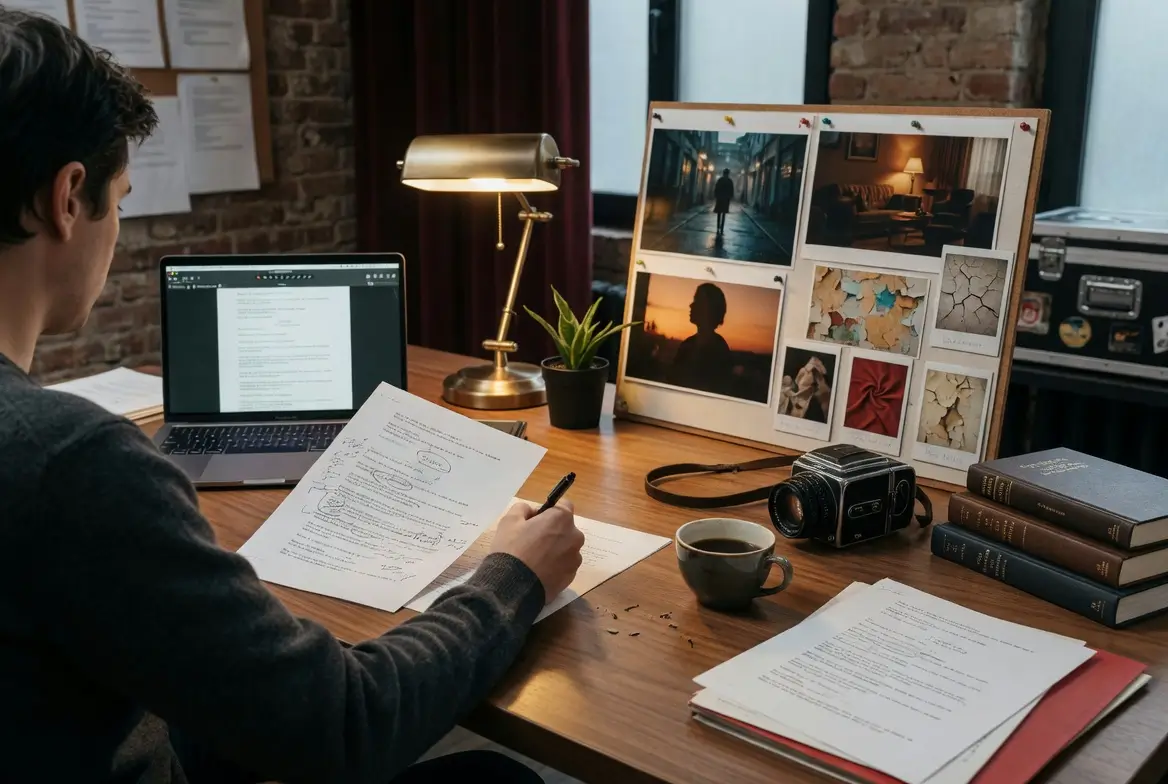
One video script well-built provides three measurable benefits. First, it ensures the consistency of the message: every second serves a specific purpose, without digression. Second, it drastically reduces shooting and editing time: a clear script means 40% fewer takes according to our feedback on 500 productions. Thirdly, it makes it possible to create a genuine Storyboard for business which aligns all stakeholders before D-Day.
But above all, a structured script makes it possible to apply a proven method like AIDA, which transforms a descriptive video into a video that converts. Because video is not content: it is a persuasion device that should guide your viewer from click to action.
The AIDA method applied to the video script
AIDA is a copywriting framework that was born in 19th century advertising, but its logic remains unbeatable for structuring a video script in 2026. The acronym stands for Attention, Interest, Desire, Action. When you apply these 4 steps to your script, you transform a succession of information into a coherent emotional journey.
A for Attention: the hook for the first 3 seconds
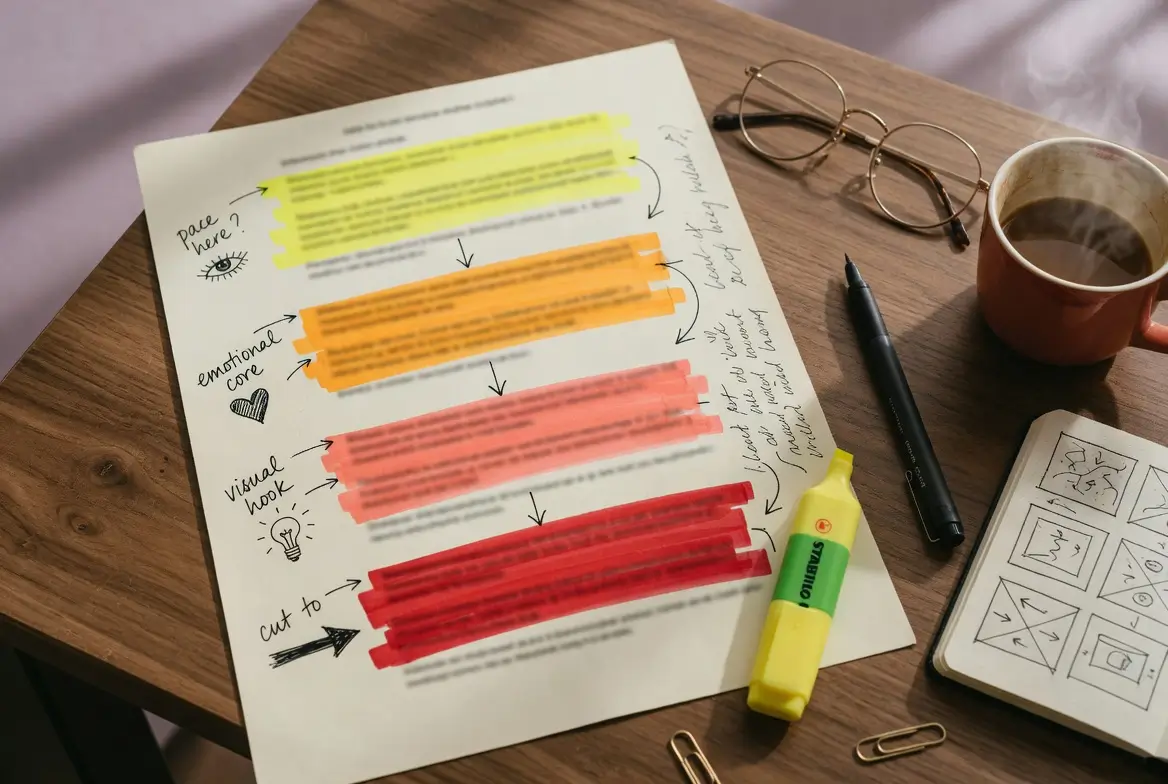
The hook is the promise, the question, the visual or the shocking phrase that prevents your viewer from scrolling. In 2026, you have 3 seconds to do this work, not one more. A good hook meets three criteria: it is specific, it creates emotional tension, and it promises a clear response.
- Hook question: “Why do your LinkedIn videos get fewer than 100 views?” This formulation directly appeals to the target and promises a response.
- Counter-intuitive hook: “Stop putting your logo as an intro to your videos.” Breaking with an expected norm gets immediate attention.
- Hook number: “This technique has increased the completion rate of our customers by 4.” A concrete number increases credibility from the first second.
- Visual hook: An unexpected action on the image (a falling object, a sudden change of scenery). Especially effective on TikTok and Reels.
- Hook problem: “If your video isn't converting, it's probably because of this error.” The hook problem activates curiosity and productive worry.
I for Interest: developing the promise
Once attention is captured, you have about 7 to 15 seconds to establish interest. This is where you contextualize the problem, prove your credibility, and make you want to go all the way. A well-written video script avoids empty sentences and prefers tangible elements: a customer case, a sector figure, a concrete anecdote.
D for Desire: the solution and its benefits
The Desire phase occupies the heart of your video script, generally between 15 and 50 seconds for a short video, or up to 3 minutes for a corporate video. You present your solution, your methods, your results. The golden rule: sell the benefit, not the functionality. Rather than “our software integrates 12 functionalities”, prefer “your teams save 6 hours per week”.
A for Action: the explicit CTA
Too many video scripts end up in a soft pirouette (“There you go, see you soon!”). But without an explicit CTA, your video is a lost investment. The CTA should be unique (a single action), formulated imperatively, and placed at a time when emotional engagement is at its peak. Examples: “Download our checklist”, “Book 15 minutes with an expert”, “Comment on the word DEMO and we'll send you the template”.
The 5 video formats and their AIDA template
Not all video formats are scripted the same way. A 2-minute corporate video does not follow the same pace as a 15-second TikTok. The table below summarizes the 5 formats that we produce daily at Kosmos, with their specific AIDA template. These templates are the result of more than 500 productions delivered and A/B tests conducted on dozens of customer campaigns, including the Mercedes-Benz brand for BPM content, or Club Med for ambient videos.
This table is your starting point, but each format needs to be adjusted according to your audience and sector. For example, a B2B SaaS corporate video script will adopt a more didactic tone than a luxury corporate script, which will emphasize emotion and silence. Mastering these nuances requires real editorial expertise, which is why more and more companies are delegating the writing of their scripts to an experienced video agency.
How to write a hook that captures in 3 seconds
The hook is the most strategic element of your video script. It is also the one that the majority of businesses botch. However, 80% of the result of your video depends on this half-sentence. Here is the 3-second hooks checklist that we systematically apply at Kosmos to ensure a hook that works.
- Impacting first word: Avoid “good morning,” “today,” “in this video.” Prefer “stop”, “imagine”, “here's why”, “this graph will shock you”. These openings break the automatic scroll.
- Specificity: A generic hook (“marketing is changing”) does not work. A specific hook (“87% of B2B emails end up in spam because of this tag”) is picked up immediately.
- Coherent visual: The hook is more than just text. The first image must also break with the expected: a close-up of a face, an incongruous object, a large number.
- Subtitle from the 1st second: 85% of videos on Meta are watched without sound. If your hook isn't subtitled, it's invisible.
- An enduring promise: A soliciting hook that does not keep its promise generates massive churn. Promise exactly what you are going to deliver.
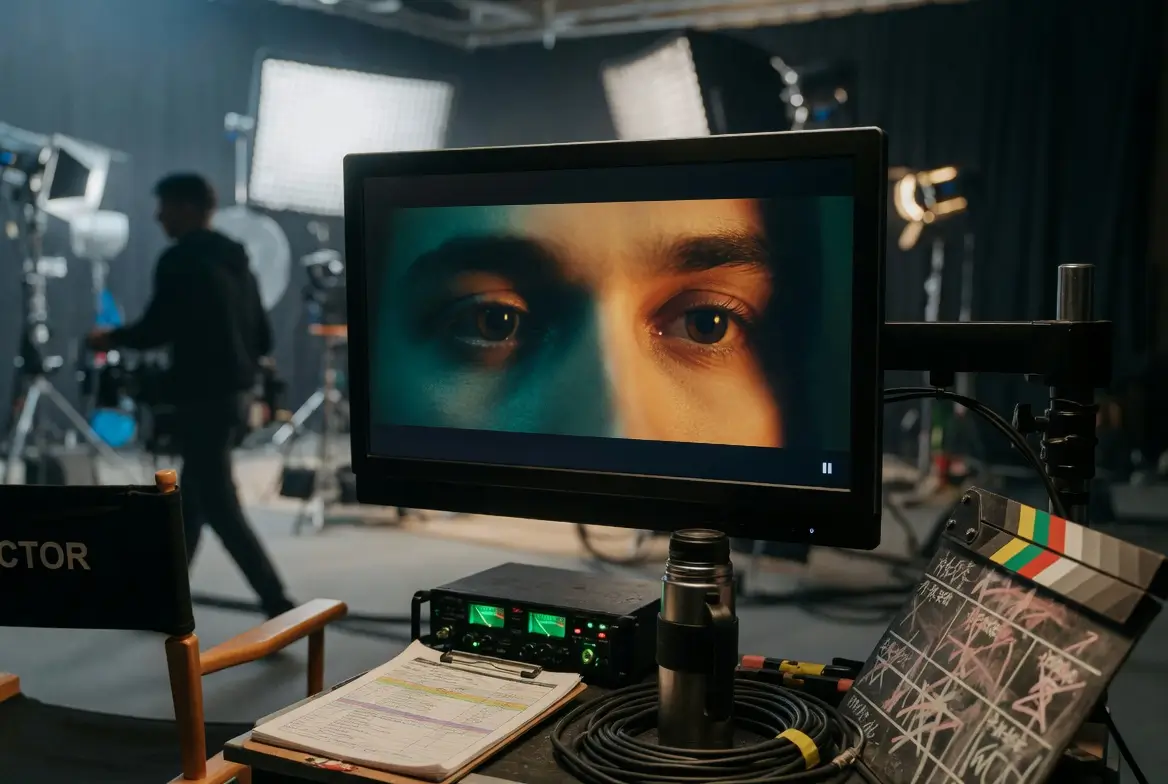
A tip that works particularly well: test 3 hook versions on the same content, and launch A/B tests on the first publications. You quickly identify the formula that resonates with your audience, then you industrialize it over the following episodes. This continuous testing logic is what separates channels that peak at 1,000 views from those that peak at 100,000 views.
Critical mistakes to avoid in a video script
Out of the 500 productions supported by Kosmos, the same mistakes come up again and again, especially among companies that write their scripts in-house without a method. Avoiding even half of it would already transform the average performance of your videos.
- Start with a presentation: “Hi, my name is X and I am CEO of Y.” Nobody stays for it. Start with the benefit or the problem, show up to the 8th second maximum.
- Wanting to say everything: An effective video script carries a single message. If you have 3 ideas, make 3 videos. Dispersion kills conversion.
- Forget the oral dimension: Read your script out loud before shooting. If a sentence does not pass orally, it will not appear on the screen. Prefer short sentences, rhythm, and breaths.
- No rhythm variations: A monotone script loses 30% more audience every 30 seconds. Alternate short/long sentences, tight/wide shots, silences/music.
- CTA drowned in the end: “There you go, feel free to like, comment, comment, share, subscribe and visit our site.” Nobody does 5 actions. Choose ONE action, clearly formulated.
- Neglecting the writing phase: Many businesses improvise their professional video shooting without a successful script. The result: 30% more shots, 50% more editing time, and a diluted message.
- No proofreading by a third party: A script that is read only by its author always contains blind spots. Have someone from the sales or marketing team read it before final validation.
And a more subtle mistake: underestimating consistency with your video marketing strategy global. An isolated script can be brilliant, but if it is not part of a logic of tunnel and message repetition, it has little effect on your business. It's the video ecosystem that converts, not the isolated nugget.
Kosmos case studies: 2 scripts that made a difference
To make the method concrete, here are two examples taken from our internal production. These two cases illustrate how a good script structure radically changes the results, for an equivalent production budget.
Case 1: Mercedes-Benz BPM customer story
For BPM Mercedes-Benz, we produced a customer testimonial on after-sales service. The first version of the script, written in-house by the customer, started with a 30-second presentation of the dealership. LinkedIn completion rate: 18%. We rewrote the script by placing the customer result in a hook: “I saved 4,000 euros on the annual maintenance of my fleet.” The context of the dealership came in the 25th second, after the emotional clash. The completion rate increased to 67%, and the video generated 22 qualified RFQs in 6 weeks.
Case 2: SaaS B2B explanatory video
For a B2B SaaS (NDA) customer, we worked on a 90-second product explanatory video. The initial brief called for a video “that explains all the features.” We've reframed: a script can't cover 12 features in 90 seconds without losing the audience. The final script focused on ONE business problem (the loss of time in qualifying leads) and ONE solution (the integrated scoring algorithm). Result: 71% completion rate, and 14% of landing visitors converted to a demo, compared to 3% with the previous “exhaustive” video.

How to integrate video scripting into your production process
One video script is not an isolated deliverable, it is a precise step in the production chain. Here is the workflow that we recommend at Kosmos to industrialize production without sacrificing quality, especially useful if you produce several videos per month.
- Step 1, Strategic Brief (1h): Define the business objective, the target, the format, the distribution channel, the only key message.
- Step 2, Research and angles (2-3h): Study the competition, identify the differentiating angle, validate the promise to be made in the hook.
- Step 3, Writing the v1 script (2-4h): Apply the AIDA structure of the chosen format, write with the oral dimension in mind, provide visual indications.
- Step 4, Cross-review (1h): Reading aloud by a third party, rhythm adjustments, CTA validation.
- Step 5, Storyboard (2-3 hours): Transform the script into a storyboard, shot by shot, with precise timing.
- Step 6, Shooting (depending on format): With a successful script, shooting is 40% faster than in improvised mode.
- Step 7, Post-production (variable): Since the script serves as a roadmap for editing, the editor also saves 30% of time.
This methodology drastically reduces the total cost of production while improving results. A well-done script is typically 20% of the total budget but 80% of the final result. To go further on the strategic dimension, the method Pitch Anything by Oren Klaff offers complementary frameworks for attention-capture and pitch storytelling, useful for scripting demanding B2B commercial videos.
The tools to write and test a video script in 2026
The tool ecosystem has evolved a lot. Here is the stack that we use at Kosmos to write, share and validate our scripts as a team.
- Notion or Google Docs: For collaborative writing. Allows you to comment, suggest, validate in real time with the customer.
- ChatGPT and Claude: As assistants to generate 3 hook variants, brainstorm angles, or test oral readability. Warning: never publish an AI-generated script without human rewriting.
- Eleven Labs or synthetic voices: To hear your script before shooting. Useful for identifying sentences that sound bad when spoken.
- Frame.io: To share the rushes with the customer and get accurate timecoded feedback. Also ideal for validating that the filmed script corresponds to the written script.
- Storyboarder: Free tool to quickly turn a script into a visual storyboard, even without drawing skills.
But beware of the all-AI trap. A video script generated entirely by ChatGPT sounds empty, lacks specificity, and reproduces the same structures as thousands of other scripts generated. AI is an assistant, not a writer. The added value remains in the strategic brief, the concrete examples experienced, and the brand voice, three things that AI cannot invent by itself.
Use an agency to write your video scripts
When your production volume exceeds 2 videos per month, or when the business challenge is important, delegating script writing to a specialized agency becomes profitable. A good agency brings three things that an internal team rarely has: a methodology proven over hundreds of productions, an external perspective that avoids the “tunnel” effect specific to internal teams, and editorial know-how specific to each video format.
Chez Kosmos, our team of writers and designers work hand-in-hand with directors to ensure that each script is not only well-written, but also capable of being shot and edited effectively. This production dimension is often overlooked by pure writers: a script that is brilliant on paper but impossible to shoot in less than 8 hours costs more than it pays off.
Our approach combines four pillars: strategic analysis of the brief, AIDA-oriented writing, oral validation of the script, and alignment with the storyboard. All while integrating the specific constraints of your distribution channel (LinkedIn, YouTube, TikTok, site, lounge) and your target audience. To discuss your video project, the Kosmos team can be reached via Contact page of the agency.
Video script FAQ
What is the ideal length for a video script in 2026?
The ideal length depends strictly on the format. For a Meta or YouTube ad, aim for 60 to 90 words maximum (15 to 30 seconds). For a corporate video on a website, 270 to 450 words (90 to 180 seconds). For a customer testimonial, 180 to 360 words (60 to 120 seconds). For a TikTok or Reels, 45 to 135 words (15 to 45 seconds). The universal rule: count about 3 words per second of video in natural bitrate. If your script exceeds this density, you will speak too quickly and lose clarity. If you're below, you're probably having too much visual downtime.
Should you always start with a hook in a video script?
Yes, always, but the type of hook varies by channel. On social networks and ads, the hook must be brutal and immediate (3 seconds). On a corporate video hosted on your site, where the visitor has already shown interest, the hook can be more relaxed (8 to 12 seconds) and focus on the business context. But regardless of the channel, never start with “Hello, my name is...” This opening costs 30 to 50% of completion based on our measurements on 500 Kosmos productions.
How do I adapt a video script to multiple formats?
The best practice is to write a master script in the longest format (for example 180 seconds corporate), then to break it down into shorter versions for ads and snack content. Concretely, you extract the hook and the main solution in 30 seconds for ads, and 3 to 4 highlights in 15 seconds for TikTok or Reels. This repurposing logic saves up to 60% of the overall writing time, while increasing the scope of your shooting. A single production can feed 8 to 12 different contents if it was designed modularly from the script.
Does the video script need to include shots and music details?
Yes, ideally your script has two columns: the voiceover or the dialogue on the left, the visual and audio indications on the right. This double column allows the director, cameraman and editor to immediately visualize what should happen to the image. For short videos (less than 30 seconds), the instructions may remain brief. For a 2-minute corporate video or corporate movie, provide precise instructions shot by shot. This preparation drastically reduces questions about filming and ensures that the final result corresponds to the original intention.
How long does it take to write a good video script?
For a professional-quality script, allow 4 to 8 hours for a 60 to 120 second video. This includes the strategic brief, researching the angle, writing the first draft, two to three iterations, oral reading, and final validation. Sloppy 30-minute scripts are almost always the cause of videos that don't perform. If you produce in-house, plan for this time budget. If you delegate, count 400 to 1,200 euros excluding VAT depending on the complexity of the brief and the final format.
Can you write a video script without copywriting experience?
Yes, as long as you rigorously apply a method like AIDA and test your scripts before shooting. The first scripts will necessarily be less efficient than those of an experienced copywriter, but the gap is quickly reduced with practice and the feedback of metrics. Three tips to get started: study 50 videos in your sector by noting their hooks, write each script in two steps (first free draft, then AIDA structuring), and always have a third party proofread before shooting. After 10 to 15 scripts, your level will have improved considerably.
In summary
One video script successful in 2026 is based on three fundamentals: a hook that captures in less than 3 seconds, an AIDA structure that guides the viewer, and an explicit call to action. With an average attention drop to 2.7 seconds on social networks and 65% abandonment in the first 10 seconds, improvising is no longer a viable option.
The 5 major formats (corporate, ads, TikTok, testimonial, explanatory) each require a specific structure, but the logic remains constant: a unique message, concrete benefits, social proof, a clear CTA. Mastering these AIDA templates makes the difference between a video that generates 200 views and a video that generates 200,000 views.
Kosmos supports more than 500 customers in the writing and production of their video scripts, with a proven methodology and a professional studio in Bordeaux. From strategic design to post-production, our team ensures that every second of your video serves a measurable business objective.
Ready to turn your videos into a conversion driver in 2026? Talk with a Kosmos expert to frame your next video project and benefit from our AIDA templates customized to your brand.