.webp)
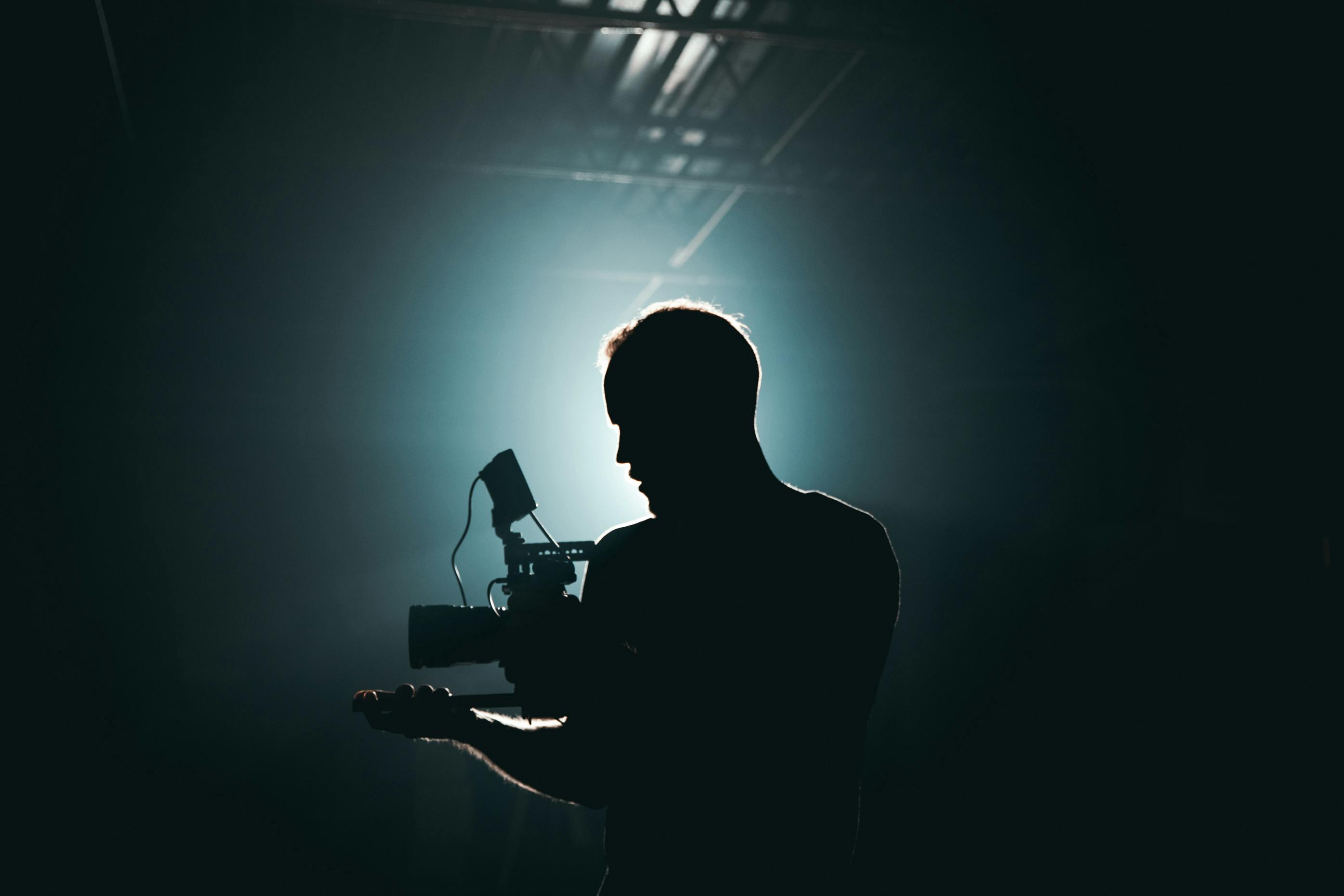
An institutional video is that 1 to 3 minute film that tells you who you are, what you do and why you do it better than others. Unlike a product ad or a customer testimonial, this format lays the foundations of your brand image. It is aimed as much at your prospects as at your future talents, your investors and your partners. In other words, it's your audiovisual identity card.
Kosmos supports companies in the production of their corporate film to make a lasting impression. And the numbers prove it: according to a HubSpot 2026 study, 95% of a video message is retained compared to only 10% via text, and 73% of B2B decision-makers watch a brand movie before contacting a service provider. In other words, this lever is no longer optional.
This format offers three concrete benefits. First, it humanizes your brand by highlighting your teams, your site, your know-how. Then, it accelerates the sales cycle: a prospect who watches your movie arrives at an appointment already 60% convinced. Finally, it pays for itself over 2 to 3 years because it can be used on the site, at a trade show, as an investor pitch, in HR onboarding and on LinkedIn.

Why corporate video became a must in 2026
In 2026, audiovisual brand content is no longer a nice-to-have. It has become a standard of B2B credibility. A company without a brand film comes across as less solid, less modern, less confident in its own story. Your website may be flawless, your pitch deck polished, but faceless and speechless, you're still a silent brand.
LinkedIn, YouTube, and even Google algorithms are now prioritizing video content. According to Cisco, 82% of Internet traffic in 2026 is consumed on video. And more importantly, the memory rate of a well-produced movie reaches 95% at 24 hours, compared to 10% for an equivalent text. This difference radically changes the effectiveness of a commercial approach.
Your corporate film therefore plays three complementary roles. First, it reassures: a B2B buyer who sees your premises, your employees and your manager express themselves immediately humanizes the relationship. Second, it differentiates: in a sea of copy-and-paste promises, your tone and artistic direction set you apart. Thirdly, it makes money: the same movie feeds your site, your LinkedIn page, your trade shows, your commercial emails and your HR onboarding for 2 to 3 years.
The concrete objectives of a corporate film
Before you produce, you need to clarify what you want your movie to achieve. Without a specific objective, you end up with a generic result that appeals to everyone and that does not convert anyone. Here are the 4 main objectives that an institutional video can serve, sometimes simultaneously, but with a clearly prioritized focus.
- Strengthen your reputation: you are looking to exist in the spirit of a market. Epic format, loud music, aerial wide shots, warm voiceover. Ideal duration: 60-90 seconds. Broadcast: home page, YouTube pre-roll, living room screens.
- Convert your prospects: You want video to speed up your sales cycle. Educational approach, product demonstration, integrated customer testimonial. Duration: 90-180 seconds. Distribution: landing pages, commercial emails, funnel background.
- Attracting talent: you aim for your employer brand. Employee testimonies, floor plans, working environment. Duration: 60-120 seconds. Distribution: career page, LinkedIn, student fairs.
- Reassure your investors: You are preparing a survey or a pitch. Quantified growth, management vision, prestigious customer cases. Duration: 90-120 seconds. Distribution: data room, board meeting, due diligence.
A classic trap is to want to check off all 4 goals in a single movie. Result: your result becomes a diluted patchwork. It is better to produce a 90-second hero movie that is ultra-aligned with the main objective, then turn it into 3-4 short capsules for other uses. It is the logic of repurposing that our corporate video approach details in depth.
The 5 steps to a successful corporate film
A successful institutional video is based on a rigorous method. Improvising means exposing yourself to expensive reshoots and a disappointing deliverable. Here is the complete pipeline that Kosmos applies to each project, from brief to distribution. Count 8 to 12 weeks for a standard project, 14 to 16 weeks for a premium production such as Mercedes BPM or Ritz Paris.
Step 1: Strategic brief and benchmark
It all starts with the brief. If you miss this step, the rest falls apart. A solid brief specifies your positioning, your target audience, your 3 key messages and your 3 success KPIs. Don't just say “I want a good movie.” Be surgical about what you want the viewer to feel, understand, and do after viewing.
- Specific persona: Who is watching your movie? A CFO of SMEs? A major buyer? A future intern? The tone changes radically depending on the target.
- Competitive benchmark: Watch 8 to 10 productions from your sector. Identify what works, what sounds wrong, and where you can stand out in artistic direction or storytelling.
- 3 key messages: What does the spectator absolutely have to remember? Keep 3 at most, otherwise your result becomes a catch-all.
- Measurable KPIs: 75% completion rate, leads generated via CTA, LinkedIn shares, increased average time on the home page.
Allow 1 to 2 weeks for this phase. Involves marketing management, sales management and manager. This is also when you frame the budget.
Step 2: Writing, Storyboarding, and Pre-Production
A corporate movie script is written in 3 to 5 versions. Never validate the first one. The script must keep the promise of the brief while being shootable, that is to say compatible with the shooting constraints (locations, available people, budget). The storyboard then turns each line of the script into a precise visual plan.
- Script: voiceovers, dialogues, duration per sequence. Aim for 130 words per minute for a natural flow.
- Storyboard: 1 thumbnail per shot, with frame, camera movement and duration. It is the visual contract between the client and the agency.
- Spotting: visit to filming locations, light validation, technical constraints (noise, access, authorizations).
- Casting: selection of collaborators who speak on the screen. Prepare an individual brief for each, 3 days before shooting.
- Scheduling: detailed service sheet to the hour, validated by all stakeholders.
This phase lasts 2 to 3 weeks. If you take a shortcut here, you'll pay for it at the shoot. To go further on this logic of visual structuring, our guide to creating a business storyboard details the complete method.
Step 3: Shooting
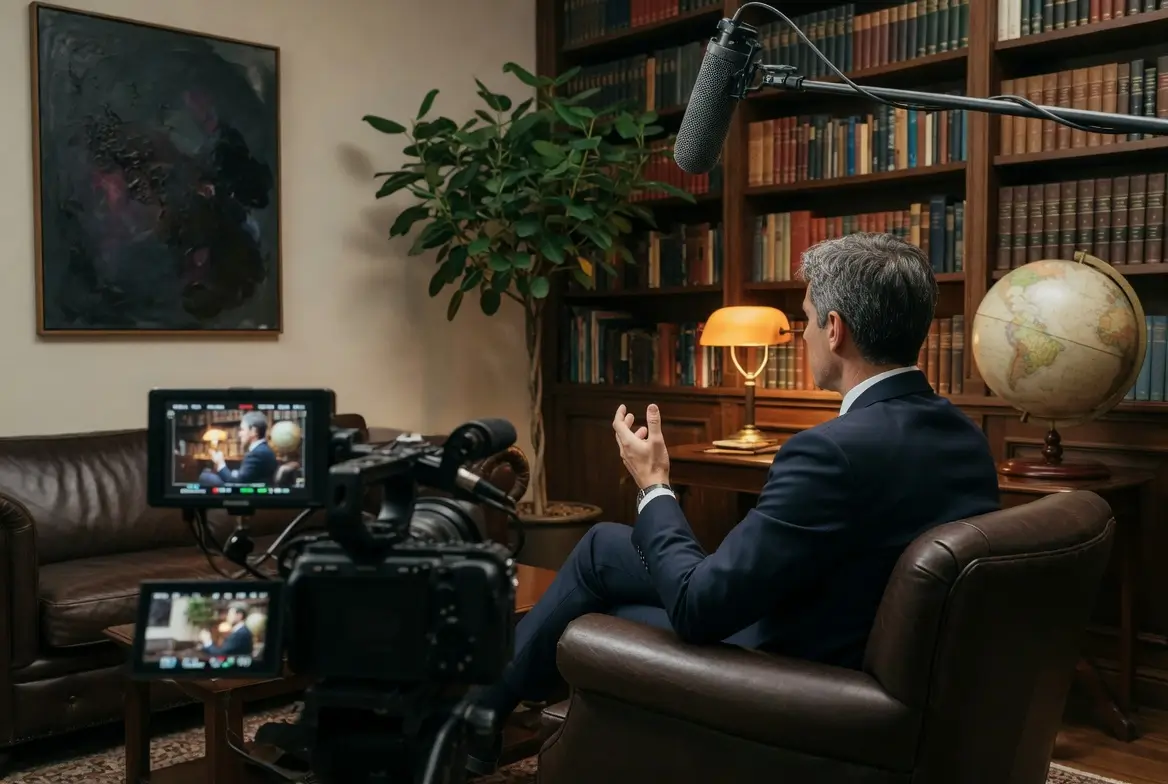
On D-Day, the film crew arrives on your premises with cameras, lights, microphones and a green background if necessary. Count 1 to 3 days of shooting depending on the format. For a premium production like Mercedes BPM, Kosmos mobilizes 6 to 8 people: director, cinematographer, sound engineer, machinist, makeup artist, assistant, artistic director and project manager.
- Hardware setup: 4K cameras (Sony FX6, RED Komodo), DJI Inspire drones for aerial views, cinema lenses.
- Direction of actors: collaborators are not actors. The director puts them in confidence, redoes the takes, adjusts the intentions.
- B-roll: 30 to 50% of shooting time is devoted to illustration plans (working hands, screens, office environments).
- Sound: HF lavalier microphone per speaker, boom for ambiances. Bad sound kills a good image.
Filming represents 30 to 40% of the total budget. It is also the moment when the director makes the decisions that will determine 80% of the final result.
Step 4: Postproduction
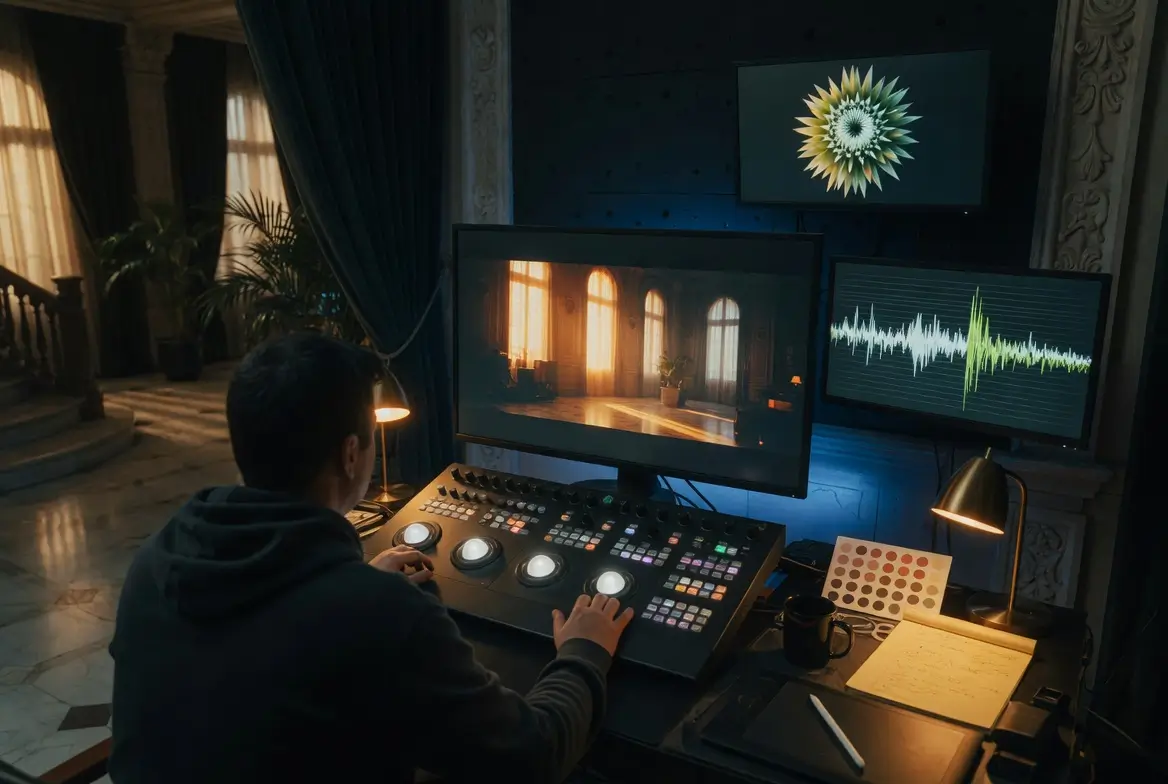
Post-production turns raw rushes into the final movie. This is often the longest phase: 3 to 6 weeks for a 2 minute format. It is divided into editing, calibration, sound design, motion design and final mixing. Each step leads to a version validated by the customer before moving on to the next.
- Mount v1: selection of the best takes, narrative structuring according to the storyboard. Duration: 1 week.
- Calibration: uniformity of colors, visual environment (warm, cold, contrasting). DaVinci Resolve or Baselight.
- Sound design: sound design, original music or Artlist license, sound effects.
- Motion design: encrypted overlays, logos, animated transitions, Linkedin-ready subtitles.
- Final mix: voice/music/effects balance for optimal distribution on all media.
Plan 2 to 3 back-to-back feedback sessions with your agency. Beyond that, you enter into invoiced revisions. Define from the start who validates what on the client side: avoid the 8-person committee syndrome that slows down each return.
Step 5: Diffusion and combinations
A movie that's sleeping on your server is useless. The distribution phase is as strategic as production. Plan the variations as soon as you brief: 60-second version for LinkedIn, 9:16 format for Instagram and TikTok, 30-second version for YouTube pre-roll, FR and EN subtitles for international use.
- Website: hero video on the home page, silent autoplay, ideal duration 30-45 seconds.
- LinkedIn: subtitled version (85% of users watch without sound), 90 seconds max, hook in the first 3 seconds.
- YouTube: full long version, optimized SEO tags (title + description + chapters).
- Exhibitions and events: 60-second version looping on screens, without essential dialogue.
- Onboarding and sales: integration into signature emails, commercial kits, customer presentations.
Then measure performance via Google Analytics, LinkedIn Analytics, and YouTube Analytics. The 75% completion rate is a great indicator. Below 30%, your hook or rhythm does not work and you need to consider a re-edit.
Budget schedule for an institutional video in 2026
The budget for such a project varies from 3,000 EUR to 80,000 EUR depending on the ambition, duration and level of production. No more giving you a single rate: it depends on your locations, your cast, your artistic direction and the number of variations. Here is a clear grid in 3 levels to frame your expectations.
The table below compares the 3 production levels on the 6 criteria that really weigh in the estimate: team, duration, deliverables, quality, shooting time and adequacy to the type of project.
The internal level is suitable for testing a format or feeding social snack content. At this price, you get a decent result but without a strong artistic direction. The local agency level is the most common: it covers the majority of B2B needs with a solid deliverable. The premium level is justified when the image is a strategic asset, for example for Mercedes BPM, Ritz Paris or Hyundai where Kosmos has delivered productions with a high level of luxury.
Beyond the initial estimate, anticipate hidden costs: voice over actor (300 to 800 EUR), musical licenses (50 to 500 EUR), drone (1,500 to 3,000 EUR/day), multilingual subtitles (200 to 600 EUR). A good quote details all these lines to avoid surprises in final billing.
Kosmos cases that prove the ROI of premium production
Talking about methods without evidence is empty. Here are 3 concrete cases where Kosmos delivered audiovisual productions that had a real business impact for demanding brands. These achievements illustrate how a well-thought-out film transforms a brand promise into a shared emotion.
Mercedes BPM: automotive prestige and raw emotion
For Mercedes BPM Group Paris, Kosmos produced a film that combines Mercedes elegance with the narrative precision of a documentary. Shooting over 3 days in Parisian dealerships, team of 8 people, drone, cinema calibration. Result: 2 minutes and 30 minutes used on the home page, in the lounge and on the group's social networks. See the Mercedes BPM achievement gives a concrete overview of what can be achieved with premium production.
Ritz Paris: luxury and heritage
The Ritz Paris has entrusted Kosmos with the image of its century-old know-how. Silky shots of the palace, portraits of chefs, cozy atmospheres: the film restores the soul of the place without falling into the postcard. The artistic direction managed each frame to respect the codes of Parisian luxury. Distribution: official site, VIP events, prestige partnerships.
Club Med, Betclic, Orange, Hyundai: the strength of a multi-sector studio
Beyond luxury and cars, Kosmos supports brands as varied as Club Med, Betclic, Orange, Hyundai and Siblu. This sectoral diversity feeds our creativity: tourism codes fuel automotive videos, the energy of a sports brand pushes the standards of a telecom player. Each project benefits from this transversality, which is what distinguishes a true audiovisual production agency from a simple technical service provider.

The pitfalls to avoid for your corporate film
Hundreds of productions are delivered each year in France. Many miss the mark. Here are the 7 most frequent pitfalls that Kosmos spots during customer audits and that hamper the ROI of well-funded projects.
- Brief blur: “We want something modern and emotional.” Without a persona or specific objective, the agency improvises and the result disappoints.
- Overly broad validation committee: 8 people who validate each cup. The result: endless iterations and a sanitized movie.
- Corporate voiceover: Too institutional tone, brochure vocabulary from the 90s. Prefer a human and direct tone, or even an authentic testimony.
- No hook in the first 3 seconds: You lose 60% of your LinkedIn audience if your openness doesn't catch on immediately.
- Excessive duration: After 2 minutes, the completion rate collapses. 90 seconds is the optimum in 2026.
- No CTA: At the end, explicitly say what to do: “Discover our services”, “Contact our team”.
- No distribution plan: shoot for 25,000 EUR then post once on LinkedIn and forget the movie. Wasted effort.
If you check 3 of these traps, your movie may end up in the graveyard of forgotten productions. Anticipate them from the moment you brief your agency: it is also the role of a real partner to challenge you.
Corporate video, corporate video or brand film: what are the differences
The terms overlap and are often confusing. Understanding the nuances helps you choose the right format and brief correctly. The institutional film establishes your global identity, the corporate video talks more about your business and your services, the brand film goes further in the emotional and creative narration.
Concretely, a typical corporate film is 60 to 180 seconds long and presents the company as a whole: who you are, what you do, your values, your teams. A longer corporate video (3 to 5 minutes) focuses on your offers and services, with an educational component. A brand film is a premium format (90 to 240 seconds) that favors pure storytelling, sometimes without even naming the brand before the end. To go further, our guide to professional video shooting details the technical requirements for each format.
The right choice depends on your objective. For a site redesign and repositioning, the classic institutional video remains the pivotal format. To support a product launch, turn to a corporate video. For a major event or a reputation campaign, the brand film opens up more creative possibilities.
Measuring the ROI of your corporate film
An institutional film is not a cost but an investment. It still needs to be measured. Many companies produce a 20,000 EUR project and never track its performance. You are missing the opportunity to optimize and arbitrate your next audiovisual budgets.
Visibility KPIs
First dimension: how many people see your video. Use native analytics from YouTube, LinkedIn, Vimeo and your web CMS. Track views, reach, average watch time, and completion rate at 25%, 50%, 75%, and 100%.
- Unique views: Avoid the trap of “views” inflated by autoplays. Measure views that exceed 30 seconds.
- 75% completion rate: excellent above 40%, mediocre below 20%.
- Organic shares: Number of times your video is shared again by your collaborators and customers on LinkedIn.
Engagement KPIs
Second dimension: how people react. Beyond passive views, engagement reveals whether your content really reaches your audience. Follow comments, reactions, saves, and direct LinkedIn mentions.
- Commitment rate: (likes + comments + shares)/impressions. Aim for a minimum of 3 to 5% on LinkedIn for a B2B institutional video.
- Feedback feeling: positive, neutral, negative. A mostly positive feeling validates your tone and artistic direction.
- Mentions and tagging: Do your salespeople, your partners, your customers rely on your video on their own networks?
Business KPIs
The third and most important dimension: does your film generate commercial results? This is where many drop out. Track the traffic generated to your site, the number of leads from the page hosting the video, the conversion rate compared to a page without video.
- Conversion lift: A/B measurement between a landing page with video and a version without. The difference is generally between 30 and 80% in favor of the video version.
- Assigned leads: CTA tracked at the end of the video, UTM parameters in your links, followed in CRM until closing.
- Sales cycle: Do prospects who have seen your corporate video convert more quickly? Often a 15 to 30% shortcut on the average cycle.
Measure from the first month but only draw conclusions after at least 6 months. An institutional film pays for itself over 24 to 36 months: a bad start can be made up for with a good recovery and expansion plan. According to a study Think with Google, brands that systematically measure their videos improve their ROI by an average of 40% on the following productions.
Institutional video FAQ
What budget should be planned for an institutional video in 2026?
Count 5,000 to 18,000 EUR for a solid local agency production, and 20,000 to 80,000 EUR for a premium production such as Mercedes BPM or Ritz Paris. The price depends on the duration of the shooting (1 to 4 days), the size of the crew (3 to 12 people), the number of locations, the variations (16:9, 9:16, short version, multilingual subtitles) and the artistic direction. An internal production with a freelance videographer costs 0 to 3,000 EUR but the rendering remains limited. Always ask for a detailed quote line by line to avoid surprises.
How long does it take to produce an institutional video?
Count 8 to 12 weeks for a standard project, and 14 to 16 weeks for a premium production. Typical breakdown: 1 to 2 weeks of brief and benchmark, 2 to 3 weeks of writing and pre-production, 1 to 4 days of shooting, 3 to 6 weeks of post-production (editing, calibration, sound design, motion design), then 1 to 2 weeks of validation and variations. If your schedule is tight, some steps may be duplicated but never deleted.
What is the ideal length for an institutional video?
90 seconds is the ideal format in 2026. After 2 minutes, your completion rate plummets by 30 to 50%. For the home page, aim for 30 to 45 seconds on silent autoplay. For LinkedIn, 60 to 90 seconds with subtitles. For YouTube, you can go up to 3 minutes if the content warrants it. The golden rule: every second should bring something. If you can cut without losing meaning, cut.
Should you use an agency or produce in-house?
If your film is a strategic asset (home page, major show, fundraiser), go through an agency. The difference in quality largely justifies the budget gap. If you produce weekly social content or onboarding clips, an internal team with a freelance videographer is enough. The intelligent compromise: agency for the movie hero, internal for short social combinations. This is the model we see at Mercedes BPM, Orange and Club Med.
How do I integrate my film into a global strategy?
Your movie is a hub, not a point of arrival. Declare it in 3 to 5 short capsules for social networks, in multilingual subtitled versions if you aim at the international level, in YouTube pre-roll to amplify in paid media. Connect it to your SEO strategy by hosting it on your home page (UX boost, visit time, bounce rate). Integrate it into your commercial emails and pitch decks. A well-exploited production must reach all of your contact points for 24 to 36 months.
What technical formats should you export for your corporate film?
Systematically ask your agency for 4 deliverables: a 4K H.264 master for archives and web broadcasting, a 1080p H.264 web optimized version (less than 50 MB), a 9:16 vertical version for Stories and Reels, a short 60-second version for pre-roll. Add subtitled versions (FR + EN minimum) with embedded subtitles and separate.srt files for later adaptation. Check that your agency delivers the raw rushes and the editing project to you: this will allow you to modify the movie 6 months later without starting from scratch.
In summary
An institutional video is your number one tool for embodying your business in 2026. 95% of a video message is retained, 73% of B2B decision-makers watch it before a first contact, and the ROI is amortized over 24 to 36 months. The format is no longer optional, it has become a B2B standard.
To succeed, apply the 5-step method: a precise strategic brief, rigorous writing and storyboarding, controlled filming, qualitative post-production, multi-channel distribution. Includes 8 to 12 weeks of production and a budget of 5,000 to 80,000 EUR depending on the ambition.
Avoid the classic pitfalls: a vague brief, too broad a validation committee, a sanitized corporate tone, excessive length, lack of a distribution plan. Systematically measures performance via completion rate, engagement, and attributed leads.
Kosmos supports demanding brands (Mercedes BPM, Ritz Paris, Ritz Paris, Club Med, Betclic, Orange, Hyundai, Siblu) in the production of premium institutional films. From Bordeaux to Paris, Monaco, Nice, Nice, Geneva and Dubai, our studio mobilizes a multidisciplinary team to transform your brand story into a shared emotion.
Start your video project in 2026. Contact us to frame your brief and receive a detailed quote within 48 hours.