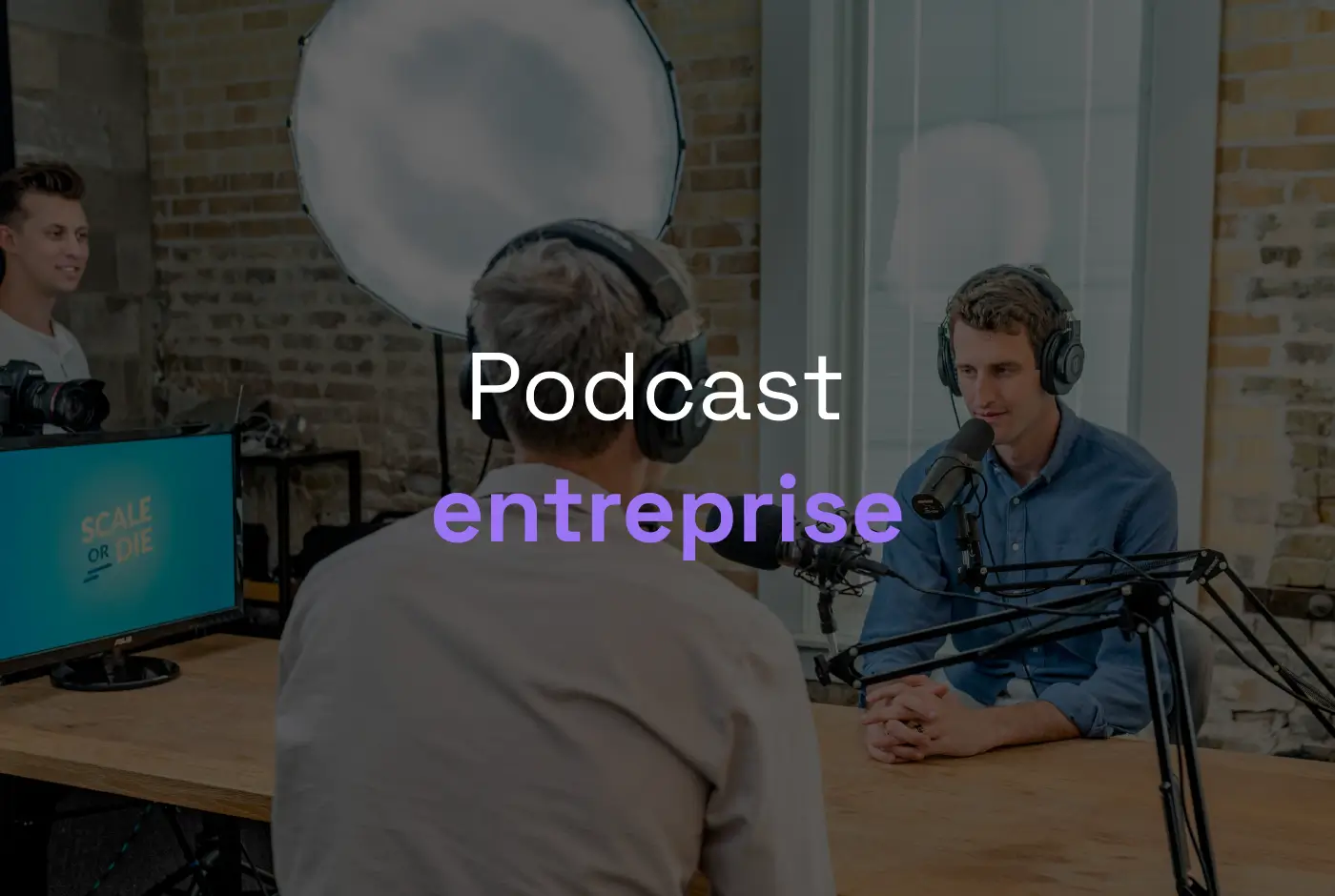

A business podcast transforms your ability to establish authority in your industry. Unlike articles or videos, podcasts create an intimate relationship with your audience. Listened to in the car, during exercise, in the evening before sleeping, the business podcast accompanies your prospects and customers in their daily lives, generating lasting trust.
Kosmos helps businesses launch and produce their business podcasts in a strategic and profitable manner. And the numbers speak for themselves: according to Ausha, 48% of French employees listen to podcasts regularly, and 67% of HR managers consider podcasts to be a powerful employer brand tool.
The business podcast offers three distinct advantages. First, a controlled production cost compared to video. Then, an ultra-engaged audience: audience rate up to 85% (vs 30% for videos). Finally, sustainability: an episode remains listenable 2 years after its publication.
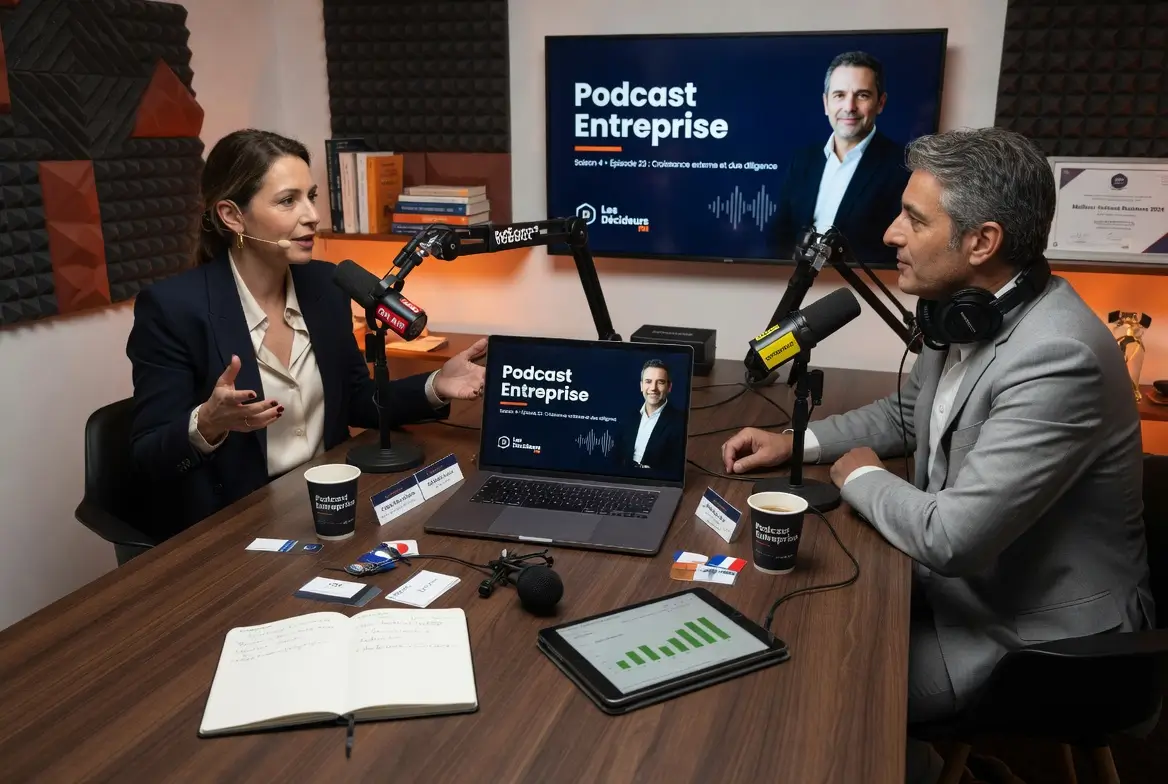
Business podcast formats that work
Not all podcasts have the same impact. Some formats generate more loyalty, others quickly attract a large audience. The choice depends on your time resource, your expertise, and your target audience.
- Interview: You interview customers, collaborators, external experts. Versatile format, easy to promote (guests talk about the episode again). Ideal duration: 30-45 minutes. Frequency: weekly or bi-weekly.
- Solo: You present insights, case studies, advice in your field. More controllable format, requires expertise in oral communication. Duration: 15-25 minutes. Frequency: flexible, weekly or monthly.
- Round table: 3-4 experts or collaborators discuss a current topic. Dynamic, natural format. Duration: 40-60 minutes. Less scalable to produce regularly.
- Storytelling: You tell the story of your company, a project, a customer. Narrative format, very engaging. Duration: 20-35 minutes. Requires careful writing.
The table below compares each format with its production characteristics, difficulty, target audience, and effort required.
Many businesses start with an interview format because it's easier to produce on a regular basis. Once established, they expand with solo episodes or panel discussions to stay fresh.
The key steps to launch your business podcast
Launching a business podcast without a strategy risks being a lost investment. Rigorous preparation over 4-6 weeks ensures a growing audience and sustainable production. Here's the complete process from concept to launch.
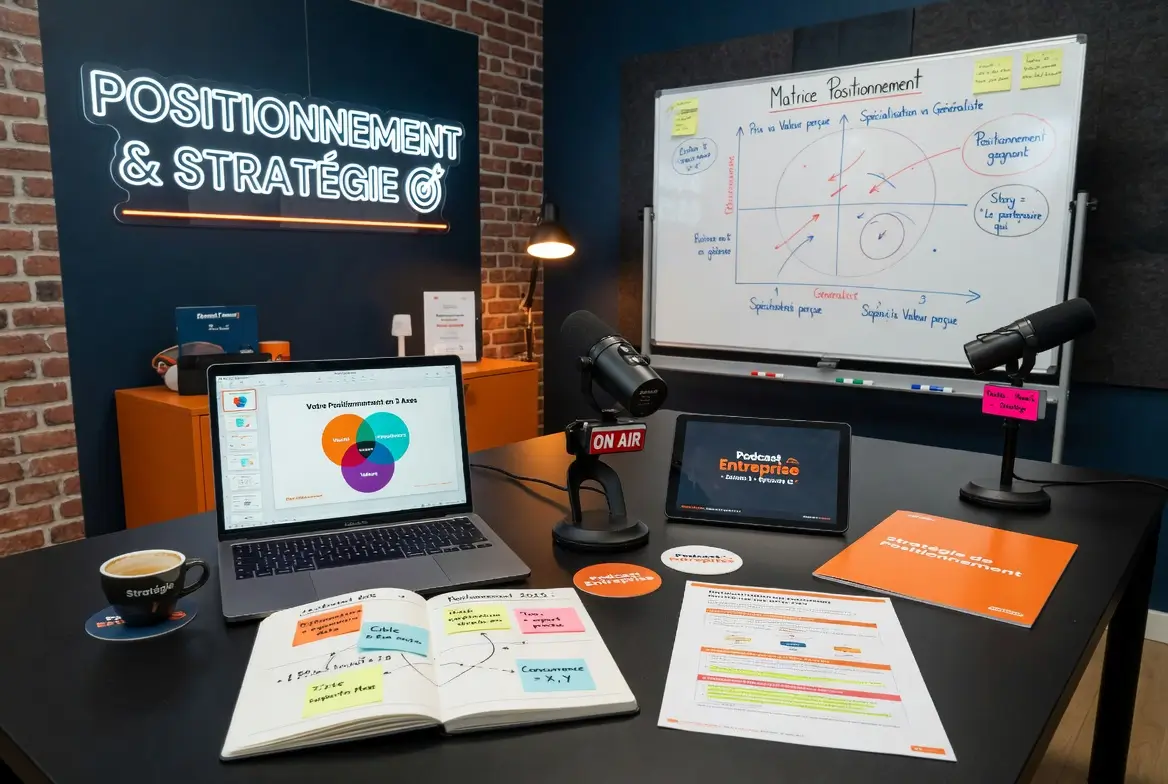
Phase 1: Define your positioning and strategy
A successful podcast clearly answers three questions: For whom? What? Why me rather than anyone else? Your business podcast should occupy a unique space in your sector. Copying does not bring anything. Innovating is everything.
- Target audience: SME owners? Employees in transition? B2B customers? Specify the audience to adapt format and subject.
- Unique theme: Don't start an “all about our agency” podcast. Position around an angle: “The underside of digital marketing”, “HR decision making”, etc.
- Competition: Audition 5-10 competing podcasts. Identify what they are doing well, and where the opportunity is for you.
- Format and frequency: Commit to a realistic timeframe. Better 1 episode/month for 2 years than 4 episodes and then stopping.
This phase lasts 2-3 weeks and involves your marketing and communication department.
Phase 2: Plan your content over 3-6 months
A sustainable business podcast is based on an editorial plan. Prepare 12-18 themes in advance to know where you are going and make it easier to find guests. Each episode should provide value: trend explained, detailed case study, recommended tool, expert opinion.
- Brainstorm themes: List 50+ episode ideas. Rank by importance and relevance for your audience.
- Guests and partners: Identify your guests (collaborators, customers, external experts). Create a list of 20-30 potentials.
- Call to action: What do you want the listener to do after the episode? Sign up for a newsletter? Visit your site? Buy? Vary CTAs.
- Branding: Choose a name, a jingle, a soundscape. Visual and sound coherence from the start.
Allow 3-4 weeks to refine this plan.
Phase 3: Set up hardware and infrastructure
You don't need a high-end studio to start a business podcast. A quality microphone, recording software and a distribution platform are sufficient. However, audio quality is non-negotiable.
- Audio hardware: Condenser microphone (type Shure SM7B or Audio-Technica AT2035): 200-400 EUR. Audio interface (Focusrite Scarlett 2i2): 150-250 EUR. Monitoring headphones (Audio-Technica ATH-M40X): 80-150 EUR. Total: 500-800 EUR minimum.
- Recording software: Audacity (free), GarageBand (free on Mac), or Adobe Audition (50 EUR/month). For remote interviews, Riverside.fm or SquadCast.
- Podcast hosting: Ausha, Podbean, Spotify for Podcasters. Cost: free at 20 EUR/month depending on the features.
- Distribution: Spotify, Apple Podcasts, Google Podcasts, Deezer. Automatic once hosted.
- Physical studio: A podcast studio in Bordeaux can welcome you for better quality recordings. Alternative to an own investment.
Total budget to start a business podcast: 1,000 EUR (hardware) + 500 EUR (software and annual hosting). Optional: studio rental for 2-3 days/month (500-1000 EUR/month).
Phase 4: Producing your first pilot episodes
Before officially launching, produce 3-4 pilot episodes as a test. Test your format, your timing, your sound. Perfect your interviewing technique. Listen in detail: background, audio level, fluidity of conversation.
- Recording: 1-2 hours to capture 30 minutes of final content (including trials and redo).
- Editing: 3-4 hours to reduce, eliminate ums/ahhs, add jingles and music, export.
- Feedback: Listen with your collaborators. Get feedback on clarity, engagement, length.
- Improvement: Iterate. You're never 100% happy with the first few episodes, and that's normal.
Allow 2-3 weeks for this phase.
Phase 5: Launch and promote
Starting a business podcast involves synchronizing multiple channels. Don't just post the episode and wait. Amplify on LinkedIn, instagram, your newsletter, your blog.
- Release schedule: Set a regular day and time (e.g. Thursday 10 am). Listeners learn to look for your new episodes.
- Blog posts: Write 1 article associated with each episode (summary, key points, resources). SEO benefit: articles generate traffic, which converts into listeners.
- LinkedIn: Post a teaser video (60s) with the cover and a teaser. Mention your guest. Ask him to repeat the episode (amplification).
- E-Mail: Include each new episode in your newsletter. Brief description and direct listening link.
- Transcoding: Turn each podcast episode into short videos (Clips) for TikTok and Instagram Reels. Repurposing reduces production costs.
The first 8 weeks are critical. Promote as much as possible: you can build an audience of 500-1000 regular listeners quickly if you are visible.
Study the intention and choose your studio
Before you start, Choosing the right podcast studio in Bordeaux (if you operate locally) or online is crucial. Audio quality determines listening by up to 40%. A professional studio reduces acoustic problems and eliminates outside distractions.
Another dimension: The personal branding of the manager via video works in synergy with a podcast. If your CEO speaks in the podcast, it's also clear personal branding. Consider repurposing the best moments into a short video to amplify their presence.
Integrate the podcast into your social media strategy
An isolated podcast will have little impact. Integrate it into your global digital communication strategy. Integrate snack content into your social media strategy shows how to turn each podcast episode into 8-10 short clips for TikTok, Instagram, LinkedIn. This cross-channel approach multiplies your reach: 1 hour of podcast = 20 minutes of short content.
Result: 1 episode generating 500 direct listeners can generate 5000+ people exposed via social clips. This is the multiplier effect of repurposing.
Measuring the success of your business podcast
Business podcast KPIs aren't just audience numbers. You also measure engagement, conversion, and the impact on your authority in the sector.
Coverage metrics
Your hosts (Ausha, Spotify for Podcasters) give you access to detailed analytics. Track total number of plays, number of unique listeners, average completion rate (% of episode listened to), and loyalty (listeners who listen to multiple episodes).
- Listens per episode: After 100 listens (first week), you gain momentum. Over 500, your podcast really settles down.
- Completion rate: Ideally 50% + for a 30-minute episode. Below 30%, remember that your content is not engaging enough or that your timing is poorly adapted.
- Regular auditors: The percentage of listeners who listen to more than 3 consecutive episodes. This measures loyalty, which is more important than the raw numbers.
Commitment and external traction
Observe the LinkedIn mentions of your podcast, the shares, the comments of the listeners. A good business podcast generates organic conversations. Also track visits to your website from the links in the show notes: use UTM parameters.
- LinkedIn engagement: Number of reactions and comments on your podcast posts. Target: 5% more engagement with your followers.
- Email clicks: CTR on podcast links in your newsletter. Compare to the rest of your content.
- Website traffic: New visits from “podcast” as source. Use Google Analytics to track UTM parameter? source=podcast.
Impact business
Finally, your business podcast should contribute to your business goals. Follow view leads generated from the podcast, conversion rate, associated revenues. A lead generated from the podcast is often of higher quality (more informed, more engaged).
- Qualified leads: Number of contacts made via CTA podcast. Compare to other channels (blog, email, social).
- Conversion rate: % of podcast leads converted into customers. Ideally above your overall average.
- Lifetime value: Revenue generated by customers acquired through the podcast. If a podcaster customer is spending 2x more than the average customer, you have a very profitable channel.
Measure from the 3rd-6th month: the first few weeks do not give a reliable signal. Then, analyze quarterly and adjust your strategy.
Common mistakes to avoid
Thousands of podcasts are launched every year. Few survive beyond 6 months. Recurring mistakes are predictable and preventable.
- Lack of consistency: Launch hard, then post irregularly. Tune the audience is not coming back. Commit to a frequency and stick to it.
- Low audio quality: Good content with bad sound cannot be listened to. Invest in hardware. It is the most important fixed cost.
- No editorial plan: Improvising every exhausted week. Prepare 12 themes in advance. You save time and consistency.
- Unprepared guests: A guest who doesn't know what they're talking about or talking in bulk ruins the episode. Brief your guests 1 week before: send 3-5 questions, suggest an angle.
- No clear CTA: At the end, tell your listener what to do: “Follow us on LinkedIn”, “Visit our site”, “Reply to this email.” Be explicit.
- Isolated podcast: Don't promote your business podcast as loudly as an article or video. Put 70% of your effort into promotion, 30% into production.
- Episodes that are too long: After 50 minutes, you lose 30% of your audience for every additional 10 minutes. 30-40 minutes is the optimum.
The majority of successful podcasts correct these mistakes after the first few months. Be humble, listen to your audience, and improve continuously.
FAQS
What budget does it take to launch a business podcast?
Minimum: 800-1000 EUR for hardware (microphone, interface, headphones) once. Then 300-500 EUR annually for software and hosting. If you use an external studio to record 2-3 days/month, add 500-1000 EUR/month. To produce in-house with a dedicated team, budget 2-3 days/month at 100-150 EUR/day (salary). Total first year: 2000-4000 EUR for a small corporate podcast, 8000-12000 EUR if you subcontract the production.
What is the most profitable business podcast format?
Interviews are the easiest to produce regularly (the co-host is the guest). Solo podcasts generate more loyalty but require more oral preparation. For ROI: aim for interview format, biweekly, 35 minutes. Each guest episode that replays the episode gives you access to their network. Indirect viral effect.
How do you attract listeners quickly?
Three levers: First, impeccable audio quality (eliminates churn). Second, a very specialized and niche theme (attracts real audiophiles). Third, massive promotion the first 4 weeks: LinkedIn 3-4x/week, newsletter, blog articles associated with each episode. Also, prepare your guests to share: ask them to repost the episode on LinkedIn 3 days before publication. This doubles your initial reach.
Do you have to be on all podcast platforms?
No Focus on Spotify (45% of global consumption) and Apple Podcasts (25%). These two are enough. Once hosted by Ausha or Spotify for Podcasters, you are automatically on Google Podcasts, Deezer, etc. Don't spread your effort across 10 platforms.
How long does it take to produce an episode?
Recording: 1-2 hours (30 min of content + essays). Editing: 3-4 hours (audio cleanup, jingles, export). Show notes and promotion: 1-2 hours. Total: 6-8 hours of work per episode. If you delegate editing to a service provider, you reduce to 2 personal hours. Budget: 100-200 EUR/episode in freelance editing.
When should you stop a podcast that's not growing?
Give yourself 6-12 months. The first 3 months, audience grew slowly (100-300 listeners). From 3 to 6 months, acceleration if your content is good (300-800). At month 6, you know if you've found your audience. If by the 6th month you are still 100 listens/episode despite promotional efforts, reconsider your format, frequency, or theme. If not, stick with it.
In summary
A business podcast is a profitable and sustainable communication tool. Controlled cost, ultra-loyal audience, long-term impact on your authority. The figures: 48% of French people listen to podcasts, and 67% of HR consider them as an employer brand tool.
Launching a successful podcast requires method: defining your positioning, planning 12 months of content, investing in audio quality, and promoting massively. The 4 main formats (interview, solo, round table, storytelling) offer flexibility according to your resources.
Measure success via completion rate (50% +), regular listeners, LinkedIn engagement, and business conversion. After 6 months with a growing audience and good metrics, you have found a profitable channel.
Kosmos supports companies in each stage of the podcast launch: content strategy, professional studio recording, editing and editing, multi-channel promotion. Our studio in Bordeaux and our expertise in digital audio make the difference.
Start your business podcast in 2026. Contact us to refine your positioning and your action plan.